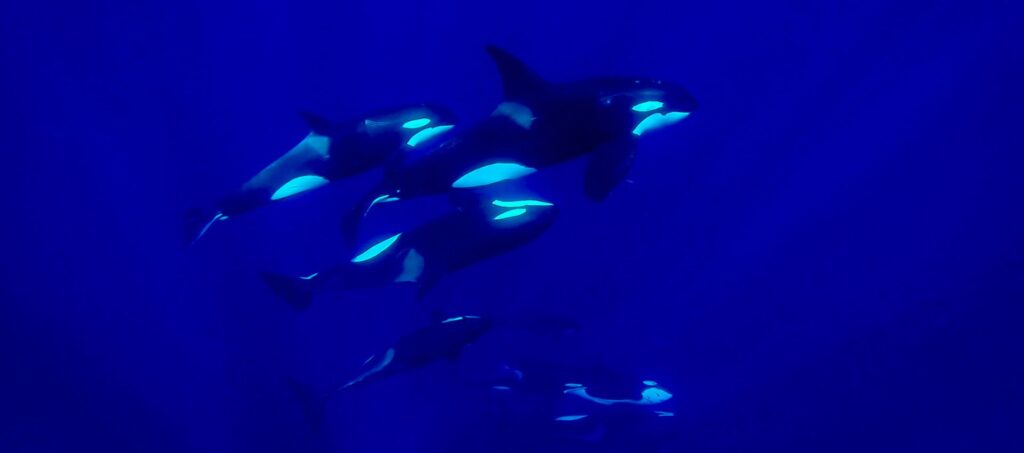


There are animals people admire. And then there are animals people feel emotionally connected to.
Orcas belong in the second category.
People cry when they see them. People travel across the world hoping for a single glimpse. People sit silently on rocky shorelines for hours waiting for one dorsal fin to appear.
But why?
Why are humans so obsessed with orcas? Why do killer whales affect people so deeply? Why are people willing to travel across the world just to see them in the wild?
The answer goes far beyond their striking black-and-white appearance or their reputation as apex predators. Orcas represent something much deeper to humans: intelligence, family, mystery, freedom, emotion, and the wildness many people feel disconnected from in modern life.
At Grey Wolf Expeditions’ Orca Camp Vancouver Island, we see this transformation happen all the time. Guests arrive hoping to “see whales,” but they often leave talking about something much harder to explain — a feeling.
Here’s why humans are so fascinated by killer whales.
1. Orcas Are Powerful… Yet Gentle With Humans
One of the biggest reasons people are fascinated by killer whales is this simple contradiction:
Orcas are among the ocean’s top predators. Yet in the wild, there are no confirmed records of a wild orca intentionally attacking or killing a human.
That fact alone captures people’s attention.
These are animals capable of hunting sharks, seals, and even large whales with precision and teamwork. They are intelligent enough to coordinate hunts, communicate across long distances, and pass knowledge through generations.
And yet, wild orcas generally show little interest in humans as prey.
That mystery creates endless curiosity.
People naturally search questions like:
- Why don’t orcas attack humans?
- Are killer whales friendly?
- Do orcas recognize humans?
- Why are orcas so intelligent?
- Are orcas emotional?
The contrast between their power and their peaceful interactions with humans creates a rare kind of respect — one rooted in awe rather than fear.
2. Orca Family Bonds Feel Deeply Human
Orcas are not just intelligent hunters. They are deeply social animals with incredibly strong family structures.
Many killer whale populations live in close-knit matrilines led by older females. Sons often stay with their mothers for life. Grandmothers play major leadership roles. Families communicate through learned vocal dialects passed down through generations.
In many ways, orcas have culture.
Humans connect emotionally to this because it mirrors something recognizable in ourselves:
- Family loyalty
- Protection
- Teaching
- Grief
- Community
- Connection
Some of the world’s most emotional wildlife stories involve orcas mourning lost calves or staying beside injured pod members.
When people witness these behaviours, it becomes difficult to see killer whales as “just animals.”
You begin to recognize emotion in them.
And that changes people.
3. Orca Intelligence Fascinates Humans
People are naturally fascinated by intelligence — especially when it appears in another species.
Orcas communicate using clicks, whistles, and pulsed calls. Different pods even have unique dialects, almost like regional languages. Some populations specialize in hunting specific prey and teach techniques across generations.
Scientists believe killer whales possess:
- Advanced problem-solving skills
- Social learning
- Long-term memory
- Emotional intelligence
- Cooperative hunting strategies
- Cultural traditions
But what fascinates people most is not just their intelligence — it is the feeling that orcas are aware.
When an orca surfaces beside a kayak, spyhops near shore, or slowly passes by a silent beach watcher, many people describe the experience as deeply personal.
It feels less like watching wildlife… and more like being noticed by it.
That emotional reaction is one reason people become lifelong orca lovers after a single encounter.
4. Orcas Represent Freedom, Wilderness & Escape
In today’s world, many people feel overstimulated, disconnected, and exhausted by constant noise, screens, schedules, and pressure.
Orcas represent the opposite.
They symbolize:
- Wilderness
- Freedom
- Presence
- Silence
- Deep nature
- Untouched ecosystems
- Family
- Connection
That is why seeing orcas in the wild often feels emotional in ways people cannot fully explain.
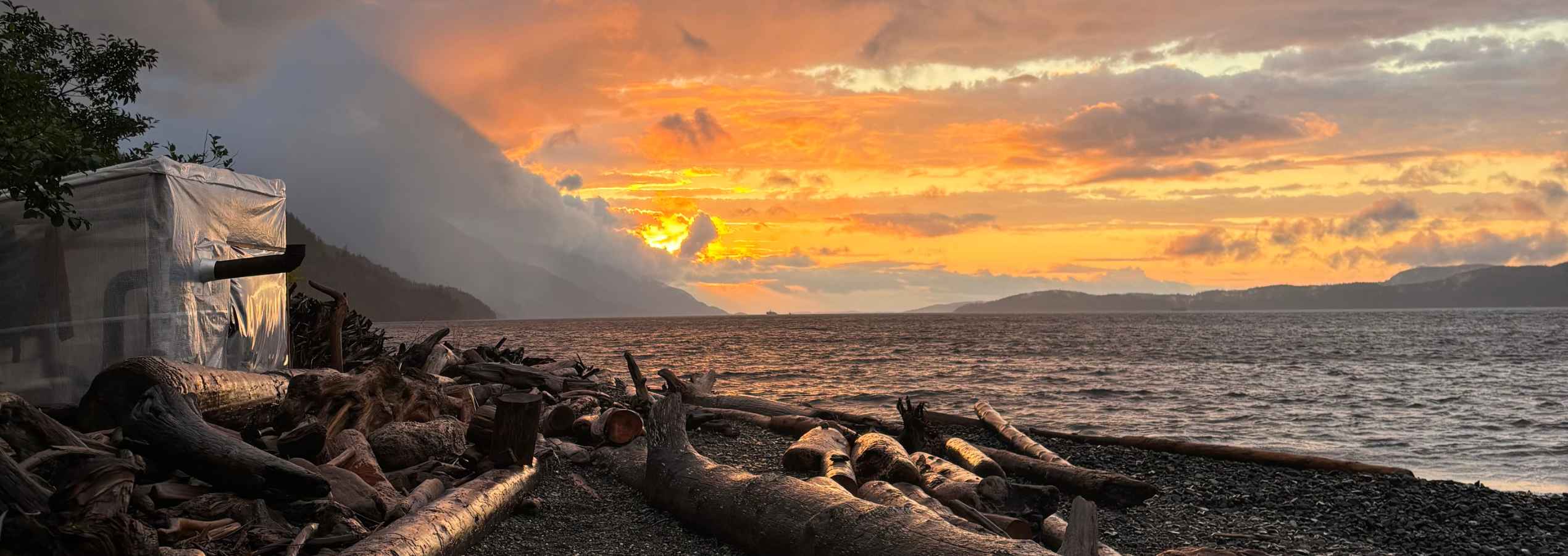
At Orca Camp Vancouver Island, guests sometimes spend hours sitting quietly on the shoreline waiting for whales. No phones. No crowds. No city noise. Just ocean, forest, and anticipation. The odd cruiseship coming through or local fisherman catching fish for its community.
And when an orca finally appears, time seems to stop.
For many people, it becomes one of the few moments in life where they feel completely present.
Not distracted. Not scrolling. Not rushing.
Just there.
The whales become a gateway back into the natural world — and perhaps back into themselves.
5. The Spiritual Connection Humans Feel With Orcas
For many people, seeing an orca is more than wildlife viewing.
It feels spiritual.
Not necessarily in a religious sense — but in a deeply human one.
People often describe feeling emotional before they even see the whales. Some cry unexpectedly. Some become completely silent. Some say it feels like the ocean is communicating something ancient back to them.
Maybe it is because killer whales move through the world with a kind of presence humans have forgotten.
They are powerful without needing to prove it. Connected without needing attention. Wild without being chaotic.
In many coastal cultures, killer whales symbolize family, protection, strength, and deep connection to the ocean.
And perhaps that is what people truly feel when they encounter orcas in the wild:
A reminder that humans were never meant to be this disconnected from nature.
For a brief moment, watching an orca surface through still ocean water, people remember something ancient inside themselves too.
Something quieter. Something calmer. Something real.
Why Orcas Continue To Fascinate The World
Even after decades of research, orcas still feel mysterious.
We still do not fully understand:
- Their communication
- Their emotional depth
- Their decision-making
- Their social dynamics
- Their relationship with humans
- Why some populations behave so differently from others
That mystery keeps people endlessly curious.
One moment, orcas are seen coordinating complex hunts. The next, they are gently rubbing beaches along Vancouver Island or carrying dead calves for days in mourning.
They feel intelligent enough to recognize us… yet wild enough to remain untamed.
And maybe that’s exactly why humans are so drawn to them.
Orcas remind us that there are still parts of nature we do not fully understand.
In a world where almost everything feels explained, documented, and controlled — that mystery feels rare.
And beautiful.
Final Thoughts
People often think they are drawn to orcas simply because they are beautiful animals.
But it goes much deeper than that.
Orcas represent:
- Power without cruelty
- Intelligence without arrogance
- Family without conditions
- Wildness without chaos
- Freedom without escape
They remind us there is still magic left in the natural world.
And perhaps that is why so many people spend years dreaming of seeing killer whales in the wild.
Not just to watch an orca…
But to feel something unforgettable.
Thank you for being here, orca lover and I look forward to your thoughts.
With love,
Sandra