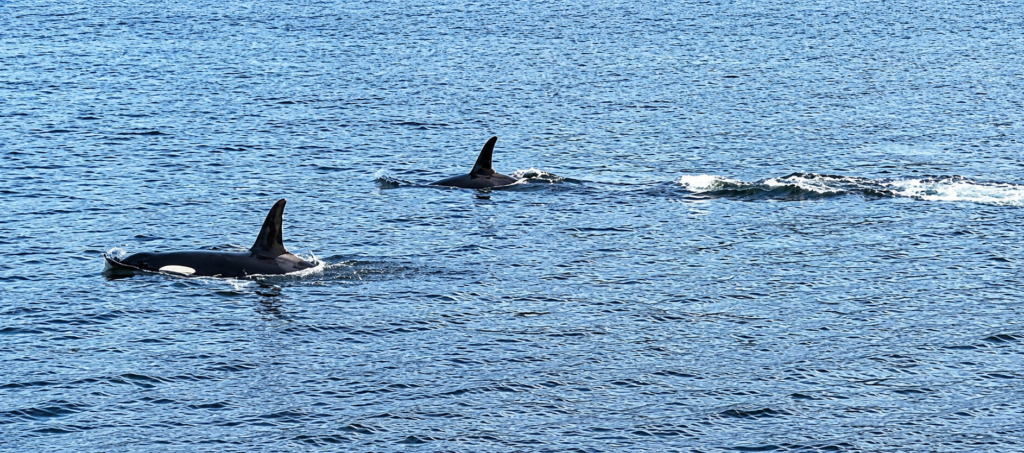


She isn’t carrying a map. She doesn’t need one. For decades, she has remembered every bend in these waters, every productive salmon run, every safe passage. Her memory is her family’s greatest survival tool.
Let’s talk about this incredible topic, shall we?
Orca Family Secrets: The Incredible Social Lives of Northern Resident Killer Whales (Part 1)
“What if I told you that somewhere beneath the calm waters of British Columbia, a grandmother is leading her family—not with force, but with memory?”
Every summer, something extraordinary happens along the rugged coastline of Northern Vancouver Island.
As the first large runs of Pacific salmon begin returning to their home rivers, another remarkable family reunion quietly unfolds beneath the ocean’s surface. The Northern Resident killer whales begin arriving in the waters of Johnstone Strait, travelling ancient routes their ancestors have followed for countless generations.
To most visitors, it’s an unforgettable wildlife spectacle.
To the whales, it’s coming home.
For over two decades, my husband Jesse and I have had the privilege of welcoming guests from around the world to Orca Camp, our remote wilderness camp nestled in the heart of Northern Resident killer whale territory. People often arrive hoping to cross one item off their bucket list—seeing an orca in the wild.
What they leave with is something much deeper.
Because after spending a few days immersed in this incredible ecosystem, most people realize they weren’t simply watching whales.
They were witnessing families.
Not just pods.
Not just marine mammals.
Families with grandparents, mothers, brothers, sisters, cousins, newborn calves, and traditions passed down through generations.
The more we learn about killer whales, the more they surprise us. Their societies are among the most sophisticated in the natural world. They communicate through unique dialects, teach their young, care for aging family members, celebrate successful hunts, and rely on the wisdom of older females whose memories can mean the difference between survival and starvation.
In many ways, they challenge how we define intelligence.
But perhaps their greatest secret isn’t their remarkable brains.
It’s their extraordinary devotion to one another.
Meet the Ocean’s Greatest Family
When people hear the words killer whale, they often picture a fierce predator.
While it’s true that orcas are apex predators—meaning they have no natural predators of their own—their lives are far more complex than their name suggests.
In fact, killer whales aren’t whales at all.
They are the largest member of the dolphin family.
That surprise alone changes the way many people think about them.
Like other dolphins, orcas are highly intelligent, incredibly social, and spend almost every moment of their lives interacting with family members. They don’t simply travel together because it’s convenient—they depend on one another for survival.
Nowhere is this more evident than among the Northern Resident killer whales that return to British Columbia every summer.
Unlike many mammals whose offspring eventually leave home to start families of their own, Northern Resident killer whales remain with their mothers for life.
Imagine a family where your children never move away.
Your grandchildren are born into the same family.
Your great-grandchildren know the same grandmother.
Generation after generation remains together.
That’s exactly how Northern Resident killer whale society works.
Scientists call these family groups matrilines.
A matriline is built around one female and her descendants. Sons stay with their mothers for life. Daughters remain with their mothers while raising calves of their own, creating multi-generational families that can include grandparents, parents, siblings, aunts, uncles, and calves travelling together every single day.
These aren’t temporary relationships.
Some of these family bonds last more than eighty years.
Imagine celebrating every birthday, every holiday, every meal, every journey, and every challenge with the same family for your entire life.
That level of lifelong commitment is almost unheard of in the animal kingdom.
The Wisdom of the Matriarch
If you’ve ever wondered who leads an orca family, the answer may surprise you.
Not the biggest male.
Not the strongest hunter.
Not the fastest swimmer.
The leader is often the oldest female.
These remarkable matriarchs have spent decades learning the intricate geography of the Pacific Northwest. They remember where salmon gather during lean years, which channels provide safe passage, where underwater currents change with the tides, and where traditional rubbing beaches can be found.
Their knowledge isn’t written down.
It lives entirely within memory.
Scientists have discovered that older female killer whales play a vital role in helping their families survive, especially during years when Chinook salmon—the Northern Residents’ favourite food—is scarce. Their experience guides younger whales to productive feeding areas and improves the survival of the entire family.
One groundbreaking study even found that adult sons have a significantly higher chance of surviving when their mother is still alive.
Think about that for a moment.
A fully grown male weighing more than 10,000 pounds may still rely on the wisdom and leadership of his mother.
Nature has many powerful mothers.
But few rival the influence of an orca matriarch.
More Than Instinct—A Culture Passed Through Generations
For centuries, people believed animals behaved almost entirely through instinct.
Today, science tells a different story.
Northern Resident killer whales possess something once thought to belong only to humans:
Culture.
Culture means knowledge that is learned—not inherited genetically—and passed from one generation to the next.
Young calves aren’t born knowing where to find salmon.
They learn.
They aren’t born recognizing every family call.
They learn.
They aren’t born understanding the safest travel routes through Johnstone Strait.
They learn.
Their teachers are mothers, grandmothers, aunts, older siblings, and the rest of their family.
Every day becomes a lesson.
Every successful hunt becomes a classroom.
Every journey strengthens traditions that may have existed for thousands of years.
That’s one of the reasons Northern Resident killer whales continue returning to these waters every summer.
They’re not simply following fish.
They’re following history.
They’re following memory.
They’re following family.
And that, perhaps more than anything else, is what makes watching them in the wild such a profoundly emotional experience.
When an orca surfaces beside its mother at Orca Camp Vancouver Island, you aren’t just witnessing a wildlife encounter.
You’re witnessing one chapter in a family story that has been unfolding for generations.
And if you’re lucky enough to experience it, you’ll never look at the ocean the same way again.
In Part Two, we’ll uncover one of the most astonishing secrets of all: why male orcas never leave their mothers, how killer whales developed their own languages, and why scientists now believe they possess one of the richest cultures ever documented outside our own species.