

What almost two decades of observation – and the science behind vessel disturbance – can teach us behind the orca’s most captivating behaviours.
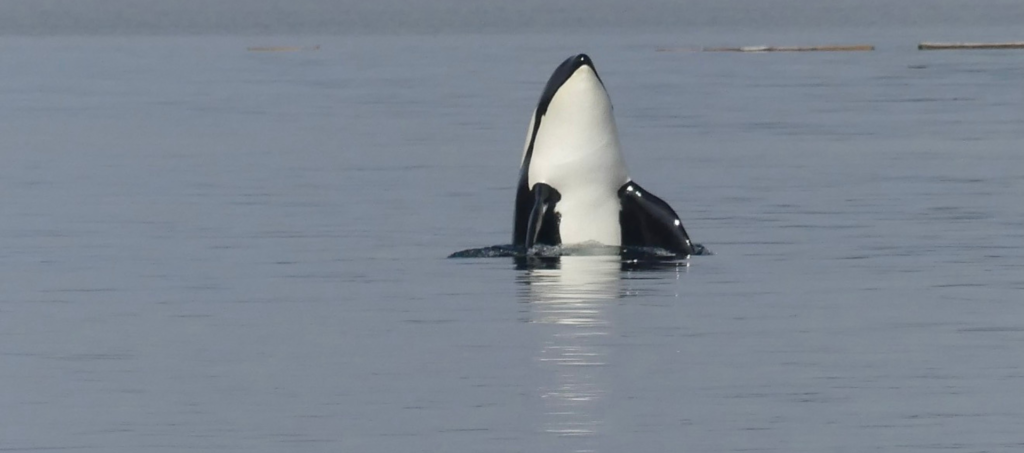
There are few moments on the water quite like a spyhop. An orca rises vertically from the ocean, sometimes bringing its eyes completely above the surface. For a few seconds, you are looking at them — and it can feel very much as though they are looking right back at you. It is spectacular. We call it spyhopping. And when it happens, cameras come up, people gasp, and inevitably someone says: “Look! It’s checking us out.” Maybe. But what if sometimes there is more to the story?
A World Built Around Sound
To understand an orca, we first have to remember that its world is very different from ours. We are primarily visual animals. Orcas live in an acoustic world. Sound travels roughly four and a half times faster underwater than it does in the air, and killer whales rely heavily on it to communicate with their families, navigate their surroundings, and locate prey. Their calls help maintain contact between members of incredibly close family groups. Echolocation clicks allow them to gather information about their underwater environment and hunt. For an orca, listening is fundamental to life. Which raises an interesting question: What happens when we make their world noisy?
Something I Have Seen More Than Once
This question didn’t begin for me with a scientific paper. It began out on the water. Over two decades of guiding and observing these animals, I have witnessed a pattern that has deeply stayed with me. On more than one occasion, I have watched orcas surrounded by multiple vessels — whale-watching boats, recreational boats, fishing boats, and sometimes kayaks and paddle boards. During several of those busy encounters, spyhopping seemed to happen again and again. It became difficult not to notice the frequency. Then there were the other encounters. The quiet ones. Times when we watched orcas with very few vessels around, or sometimes seemingly no one else nearby. In my experience, I simply haven’t observed the same frequency of spyhopping during those quieter moments. This is an anecdotal observation from years spent on the coast, not scientific evidence. It doesn’t mean vessel traffic directly triggers a spyhop, and it certainly doesn’t mean that every spyhop is a response to boats. Orcas spyhop for plenty of natural reasons when we aren’t around. But after seeing this contrast play out year after year, I started asking a question: Could an orca surrounded by heavy activity sometimes be lifting its eyes above the surface to gather visual information about what is happening around it when its acoustic world gets cluttered? That curiosity is what led me to dive into the data. What I discovered was fascinating: scientists have independently documented changes in killer whale behavior in the presence of vessels, mirroring exactly what I was seeing.
When Boats Enter the Picture
Engines, propellers, and vessel traffic introduce human-made noise into the marine environment. Scientists have been studying what that means for killer whales for decades. In 2004, researchers studying killer whales discovered that the animals produced significantly longer calls when whale-watching boats were present. Published in the journal Nature, the landmark Foote, Osborne, & Hoelzel Whale-Call Study concluded that the animals were adjusting their vocal behavior to overcome the “masking” effects of background engine noise—much like humans shouting to be heard over heavy traffic. Other research has documented changes in acoustic behavior, diving, travel direction, activity, and surface behavior associated with vessels and underwater noise. Because of this, the National Oceanic and Atmospheric Administration (NOAA Fisheries Species Directory) formally recognizes vessel disturbance and underwater noise as a critical hazard facing endangered Resident killer whale populations.
But there is another piece of research that hits particularly close to home for us at Orca Camp. This Has Been Studied Right Here in British Columbia Researchers Rob Williams, Andrew Trites, and David Bain conducted an extensive shore-based study on Northern Resident killer whales in Johnstone Strait—the very waters and population that form such an important part of our Grey Wolf Expeditions Orca Camp experience. By tracking identifiable Northern Residents from land-based cliffs, the researchers compared whale behavior under different vessel conditions. They measured swimming speed, direction, diving, and surface-active behaviors—including spyhopping. The peer-reviewed study, available via Cambridge University Press Marine Biosciences, proved that whales dynamically changed their path and movement patterns when vessels were present or experimentally approached them. Another study focused specifically on Johnstone Strait examined a practice sometimes called “leapfrogging,” where a vessel speeds ahead to position itself directly in the anticipated path of an oncoming whale. According to the International Whaling Commission (IWC) Scientific Journal, the whales responded to leapfrogging by adopting paths that were significantly less smooth and less direct. Crucially, the researchers measured a massive 14-decibel increase in engine noise when the experimental boat accelerated to get ahead. It reinforces something remarkably simple: how we operate boats around whales matters.
So What Does This Have to Do With a Spyhop?
Here is where we have to separate what science knows from what we humans naturally want to interpret. Research has firmly established that close vessel approaches increase the frequency of surface-active behaviors—including spyhops, breaches, tail slaps, and pectoral slaps. But science cannot look at a photograph of one particular spyhop and tell us exactly what that whale was thinking. We cannot say with certainty: “That whale was looking for boats,” nor can we assume “It couldn’t communicate underwater, so it had to look above the surface.” There simply isn’t data to make that specific claim. Orcas spyhop in many circumstances, including situations where there are absolutely no vessels around. And let me be clear. When I say boat or vessel, I also include kayakers and paddle boards. Even as not motorized boats, we have a impact on their behaviour. They use spyhopping to orient themselves, locate shorelines, and spy on prey like seals resting on rocks. But knowing what researchers have discovered leaves us with a fascinating thought experiment. Imagine being an animal whose world is entirely interpreted through sound. Now imagine several engines operating around you. Propellers turning. Boats shifting gears. Different frequencies arriving from different directions. People screaming and yelling. Your acoustic environment has suddenly changed. And then, you lift your eyes above the surface. What are you looking at? We don’t know for sure. And perhaps admitting that is more important than pretending that we do.
Maybe the Spyhop Isn’t Always a Performance
Wildlife has a way of making us feel like we are part of the show. A whale breaches and we cheer. A tail rises and cameras click. An orca spyhops and suddenly dozens of lenses capture that extraordinary black-and-white face above the water. It is easy to think, “Look what it did for us.” But wild animals aren’t performing for an audience. Sometimes their behavior has absolutely nothing to do with us. And sometimes—uncomfortable as it may be to consider—our presence could be part of what they are trying to figure out. That doesn’t mean every boat is harming a whale. It doesn’t mean every spyhop indicates stress. And it certainly doesn’t mean we should stop experiencing these remarkable animals. It simply means we should experience them thoughtfully.
The Best Encounter Leaves Room for the Whale
At Orca Camp, one of the greatest privileges we have is watching whales in their own environment. Sometimes that means an extraordinary close encounter. Sometimes it means watching tiny dorsal fins disappear into a misty horizon. Both are profoundly beautiful. Responsible wildlife viewing isn’t about getting the closest photograph. It isn’t about forcing our way into the perfect angle, and it isn’t about asking a wild animal to give us a show. It is about giving that animal the space to decide what happens next. The science continues to evolve. Modern acoustic tags and bio-logging technologies are now allowing researchers to record exactly what individual whales hear while simultaneously tracking their 3D movements underwater. This gives us an extraordinary window into a world we cannot see. Perhaps that is the real lesson behind the glorious spyhop. Enjoy it. Photograph it. Feel incredibly fortunate to have witnessed it. But also ask yourself: Why did that whale come up to look? Where there many boats, people, kayaks, vessels around? We may never truly know. And respecting that uncertainty might be one of the most important parts of watching wildlife responsibly. We are visitors in their world. And sometimes the greatest privilege isn’t being noticed by an orca—it’s allowing an orca the freedom not to notice us at all.
— Orca Camp Vancouver Island | Crafted by Sandra Zgela at Grey Wolf Expeditions.