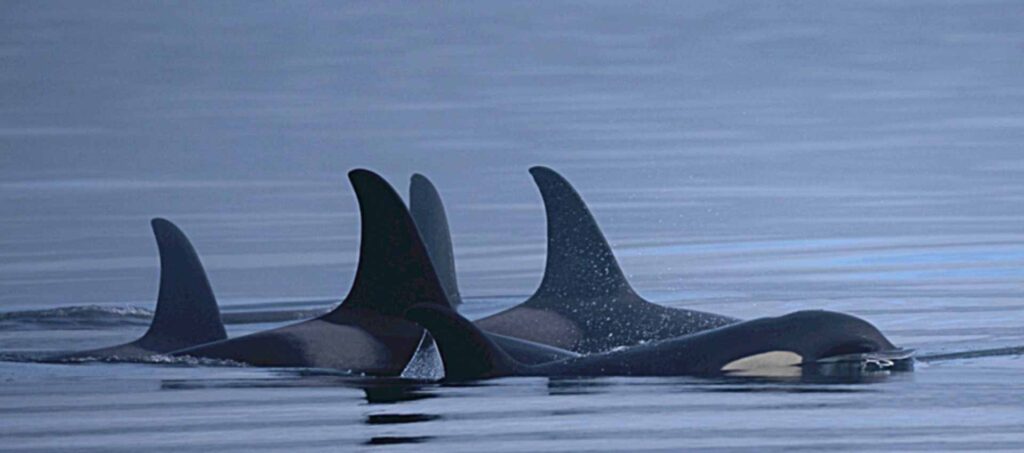


What Killer Whales May Be Feeling Beneath the Surface
Is there more to Orcas than we want to admit?
The deeper scientists, researchers, and those who spend time around killer whales look into their world, the more difficult it becomes to see them as “just animals.” From lifelong family bonds and emotional grief to advanced communication and dialects plus cultural traditions, Orcas continue to challenge what we thought we knew about intelligence in the natural world.
And perhaps one of the biggest questions of all begins with the size — and complexity — of the Orca brain.
Because the Orca brain is not only large.
It is highly developed in areas associated with:
- emotion,
- social connection,
- communication,
- memory,
- and self-awareness.
Some researchers believe Orcas may experience emotional and social lives far more advanced than we fully understand today.
Family Is Everything
For Northern Resident Killer Whales off the coast of British Columbia, family is permanent.
Male Orcas stay with their mothers for life. Grandmothers lead entire family groups through generations. Older matriarchs carry important knowledge about salmon migration routes, feeding grounds, and survival during difficult years.
These whales do not simply travel together.
They live as deeply connected societies.
Research has even shown that mothers continue sharing salmon with fully grown adult sons — something almost unheard of in the animal kingdom.
And perhaps this level of connection explains why Orcas display behaviors that appear strikingly emotional:
- grieving,
- caregiving,
- cooperation,
- teaching,
- and lifelong social bonding.
What Could Orcas Actually Perceive?
One fascinating theory surrounding Orca intelligence involves echolocation.
Orcas do not simply “hear” underwater.
They may actually perceive their environment in an entirely different way than humans can imagine.
Using echolocation clicks and returning sound waves, Orcas can create highly detailed spatial awareness of the world around them — essentially building underwater maps through sound.
Some researchers and theorists suggest this may allow Orcas to:
- identify species in complete darkness,
- distinguish salmon from other fish,
- detect movement at incredible distances,
- and potentially perceive internal biological information.
One particularly fascinating point of view suggests Orcas may even share information between one another through returning sound frequencies — almost creating a collective understanding of their surroundings.
While much of this remains theoretical and scientifically debated, one thing is becoming increasingly clear:
We likely still understand only a fraction of how Orcas experience the ocean.
And perhaps their world beneath the surface is far richer, more connected, and more intelligent than we currently comprehend.
Do Orcas Feel Grief?
One of the most emotional wildlife stories in recent history came from a Southern Resident Killer Whale known as Tahlequah.
After losing her newborn calf in 2018, she carried the calf’s body for 17 days across more than 1,000 miles of ocean.
Observers around the world watched in silence as she repeatedly lifted the calf to the surface to keep it from sinking.
The moment deeply affected millions of people because it looked heartbreakingly familiar:
grief.
Scientists remain careful about projecting human emotions onto wildlife, but increasing evidence suggests Orcas experience strong emotional attachment and prolonged social mourning behaviors.
Perhaps emotion does not belong only to humans.
More Than a Apex-Predator
The term “killer whale” has never fully captured what Orcas truly are.
Because behind the black-and-white markings exists:
- language,
- culture,
- memory,
- family,
- emotional intelligence,
- and perhaps levels of perception we are only beginning to explore.
Maybe that’s why seeing wild Orcas affects people so deeply.
Not simply because they are powerful…
but because somewhere beneath the surface, we recognize something familiar in them.
And maybe the greatest discovery still waiting for humanity is realizing that intelligence in the natural world may look very different than our own — but no less extraordinary.
Thanks for being here, and we will see you soon!