

There is something I have been thinking about a lot lately.
Attachment.
The people we love. The animals we admire. The things we hold onto. The relationships and expectations that can make us incredibly happy — and sometimes hurt us more than anything else can.
And somewhere along the way, I started wondering whether I needed to learn how to detach.
Maybe become a little less affected.
Less sensitive.
Less dependent on what another person says, does, feels or doesn’t feel.
But the more I started reading about it, the more I realized that perhaps detachment isn’t actually what I’m looking for.
There is a concept in psychology called differentiation of self.
In very simple terms, it means learning how to remain deeply connected to another person while still remaining yourself.
To love without losing yourself.
To care without carrying everything.
To allow someone else’s emotions to belong to them without automatically making them yours.
To understand that closeness and independence don’t have to be opposites.
And strangely enough, while trying to understand this in my own life, I kept thinking about the animals we spend our summers watching.
The Northern Resident Orca.
A Different Kind of Family
Anyone who has spent time around Northern Resident killer whales knows how extraordinary their family relationships are.
Resident killer whale society is built around the mother.
The basic family unit is called a matriline — typically a mother, her sons and daughters, and the offspring of her daughters.
And here’s the part that still amazes me:
Both sons and daughters generally remain connected to their maternal family for their entire lives.
A male killer whale may become enormous, eventually towering over his mother with a dorsal fin that can reach nearly two metres high.
And yet…
that’s still Mom.
These families travel together.
They forage together.
They rest together.
They communicate through calls learned and shared across generations.
Sometimes several generations of one family are swimming through the same stretch of ocean.
But they aren’t necessarily beside one another every second.
Related groups can spread out.
Matrilines can spend time apart.
Individuals forage and move within this larger social world.
And eventually they come together again.
There is connection without everything having to be constant.
Watching them has made me think differently about our own relationships.
Maybe Love Isn’t Holding On
Humans sometimes confuse love with proximity.
We think:
If you love me, you’ll choose me.
If you care about me, you’ll respond the way I hope you will.
If we’re close, I should know what you’re thinking.
If something changes between us, something must be wrong.
And when we care deeply about someone, their smallest actions can suddenly have enormous power over us.
A text.
A silence.
A comment.
A change in tone.
Something that might mean absolutely nothing to them can occupy our minds for hours.
I know this because I’m learning it myself.
And perhaps becoming healthier isn’t about teaching ourselves not to care.
Perhaps it’s learning to care without abandoning ourselves in the process.
Connected — But Still Yourself
Psychologists studying family systems use the term differentiation of self for something remarkably simple and remarkably difficult:
Remaining yourself while remaining emotionally connected to others.
It doesn’t mean becoming indifferent.
It doesn’t mean building walls.
And it doesn’t mean walking away from every relationship capable of hurting us.
Sometimes the harder work is staying open-hearted while learning where another person ends and you begin.
Their mood is theirs.
Their choices are theirs.
Their silence is theirs.
Their opinion of you is theirs.
Your responsibility is the person standing on your side of that invisible line.
You.
Maybe that’s one of the healthiest forms of letting go.
Not letting go of the person.
Letting go of the need to control what happens next.
What I Keep Seeing From Shore
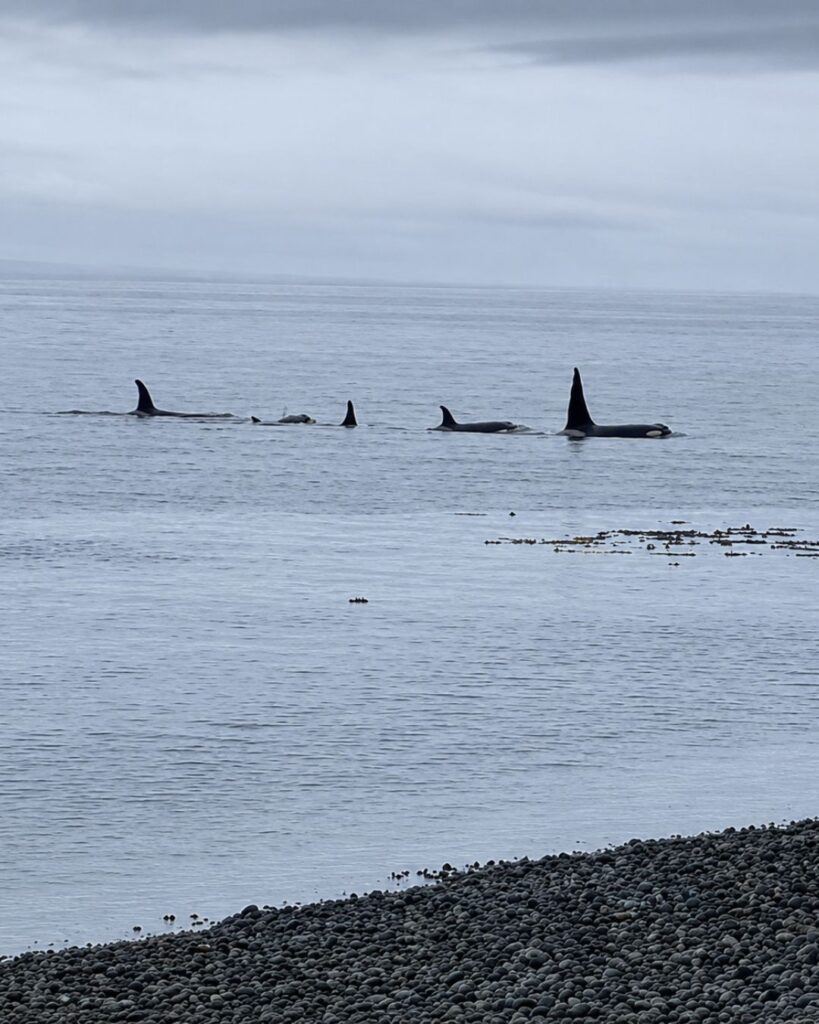
There are days at Orca Camp when a family of Northern Residents appears in the distance and everything stops.
Someone sees the first dorsal fin.
Then another.
Then another.
Sometimes they’re close together.
Sometimes hundreds of metres separate them.
Sometimes one group disappears completely from sight before appearing again somewhere we weren’t expecting.
And maybe that’s why I’ve been thinking about this so much here.
The ocean doesn’t ask anything to stay still.
The tide comes in and leaves again.
Salmon return and disappear.
Whales arrive when they arrive and leave when they leave.
Nothing out here can be controlled.
We can only be present for it.
Maybe relationships aren’t entirely different.
There are people we will love enormously.
Some will stay beside us.
Some will move farther away.
Some relationships will change shape.
And occasionally someone may remain incredibly important to us even when we have to stop reaching for them quite so tightly.
Perhaps the healthier version of me isn’t someone who learns how to feel less.
I don’t think I want to become that person.
Maybe she’s someone who can feel everything…
and still remain standing firmly inside her own life.
Someone who understands that love doesn’t require possession.
Connection doesn’t require control.
And distance doesn’t always erase what was real.
The Northern Residents will probably never know how many human beings have stood quietly on this coastline watching their families pass by and found pieces of their own lives reflected back at them.
But lately, that’s what they’ve been doing for me.
Teaching me that perhaps the opposite of attachment isn’t detachment.
Maybe it’s something much harder.
To love deeply.
To let others be who they are.
And to remain completely yourself.