

A fact-checked look at the wild record — and why captivity tells a very different story.
Welcome to my orca blog. My name is Sandra Zgela. I am the founder of Orca Camp Vancouver Island and I’d like to mention, that I am not a marine biologist. I am a passionate orca enthusiast who has been offering guided kayaking and camping tours in orca territory on Vancouver Island with my partner Jesse Haslehurst for two decades (Jesse has been guiding since 2004 in the waters of the Northern Resident Orcas.)
Orcas have one of the fiercest reputations in the ocean. They are apex predators, they hunt in coordinated groups, and they are powerful enough to take down sharks, seals, and even large whales. So it is fair to ask the question plainly:
Has a wild orca ever attacked a human in history?
After reviewing scientific literature, expert commentary, court findings, historical expedition records, and archived reporting, the clearest answer is this:
There is no documented case of a wild orca ever killing a human. In fact, a U.S. federal court reviewing trainer-safety evidence in the SeaWorld OSHA case stated that killer whales are “not known to attack humans in the wild,” that there are “no known cases” of wild killer whales killing humans, and that the four known human deaths involved captive whales in pools. A 2020 scientific review made the same point, saying there are no reliable reports of free-ranging orcas killing a human.
That does not mean there have never been tense or physical encounters in the wild. There have. But once you separate confirmed incidents from myths, exaggerations, and modern boat interactions, the list becomes surprisingly short.
The wild record: what is actually documented?
1) Hans Kretschmer — Point Sur, California, USA
Date: September 9, 1972
What happened: This is widely regarded as the only well-documented case of a wild orca injuring a human. Hans Kretschmer was surfing off Big Sur when something grabbed his leg. He reached shore with deep wounds that later required extensive stitching. Later reporting and expert commentary have suggested the whale likely mistook him for a seal, especially given the black wetsuit and sea lions nearby.
2) Herbert Ponting — McMurdo Sound, Antarctica
Date: January 5, 1911
What happened: During Robert Falcon Scott’s Antarctic expedition, photographer Herbert Ponting and the expedition dogs were standing on ice when orcas surged beneath the floe, lifting and breaking it. Ponting escaped unharmed. Experts who have revisited the account think the whales were likely displaying hunting behavior aimed at what they perceived as seal-like prey on the ice, not targeting humans specifically.
3) Ellis Miller — Helm Bay near Ketchikan, Alaska, USA
Date: August 13, 2005
What happened: A 12-year-old boy, Ellis Miller, was bumped in shallow water by a transient orca. He was not bitten and not injured. Reporting at the time noted the possibility of mistaken identity, since harbor seals frequent the bay.
4) Foxe Basin, Nunavut, Canada
Date: reportedly the 1950s
What happened: This is the one story that is sometimes cited as a possible wild fatality. It comes from Inuit recollections collected decades later and describes a young man who allegedly ignored warnings, approached trapped orcas on thin ice, and died after the ice broke. But the researchers themselves could not verify the event, and later expert commentary has suggested falling into icy water is a more likely explanation than a confirmed orca predation death. It should be treated as anecdotal and unconfirmed, not as proof of a documented fatal wild attack.
So what is the real answer for the wild?
If we are being strict and evidence-based:
No documented fatal wild orca attack on a human exists.
There is one strong, widely accepted injury case in the wild — Hans Kretschmer in California in 1972.
Everything else is either a near miss, a non-injury interaction, or an anecdotal story that cannot be verified.
That is a remarkable record for an animal with orcas’ intelligence, strength, and hunting ability.
Why captivity is different
Captivity is where the human death record changes completely.
A 2020 scientific review notes that while there are no reliable reports of free-ranging orcas killing humans, captive orcas have killed four people and seriously injured many more. The same review points to hyperaggression, artificial social grouping, inability to disperse from conflict, and chronic stress as major captivity-linked welfare concerns. In the wild, orcas can avoid conflict and spread out; in tanks, they cannot.
The OSHA litigation after Dawn Brancheau’s death also found that SeaWorld had extensive notice of the danger. Between 1988 and 2009, SeaWorld generated 100 incident reports, with multiple reports documenting injuries to trainers, and the court concluded that close-contact work with captive orcas presented a recognized hazard likely to cause death or serious harm.
The four confirmed human deaths involving captive orcas
1) Keltie Byrne — Sealand of the Pacific, Victoria, British Columbia, Canada
Date: February 20, 1991
Whales involved: Tilikum, Haida II, and Nootka IV
What happened: Byrne, a 20-year-old part-time trainer, slipped into the pool after a show. According to the OSHA decision’s summary of the coroner material, one or more whales pulled her away from the edge, Tilikum took control, and she was repeatedly submerged while rescue attempts failed. The coroner’s finding listed drowning due to forced submersion by killer whales.
Why did it happen?
No official single “motive” was ever proven. The most careful way to say it is that Byrne entered the water unexpectedly and the whales did not allow rescue. Later expert testimony in the OSHA case interpreted Tilikum’s behavior as consistent with predatory handling seen in wild foraging, but that is an expert interpretation, not a formal legal finding of intent.
2) Daniel P. Dukes — SeaWorld Orlando, Florida, USA
Date: July 6, 1999
Whale involved: Tilikum
What happened: Dukes, who was not a trainer, apparently remained inside the park after hours and entered Tilikum’s pool overnight. He was found dead the next morning draped across Tilikum’s back. The OSHA decision states his cause of death was listed as hypothermia and that it remained undetermined why he entered the pool and what role, if any, Tilikum played in the death.
Why did it happen?
This is the least clear case. It was unwitnessed, and the official record does not establish a definitive sequence. So it should not be presented the same way as the trainer deaths. The most accurate wording is that Dukes died after entering Tilikum’s pool, but the precise role of the whale is unresolved in the OSHA record.
3) Alexis Martínez — Loro Parque, Tenerife, Spain
Date: December 24, 2009
Whale involved: Keto
What happened: During a training session, Keto failed several behaviors, then pulled Martínez underwater and rammed him in the chest. The OSHA decision states Martínez died of massive internal bleeding. Subsequent reporting on the autopsy described compression injuries, organ damage, and bite marks, contradicting early attempts to describe the death as simple rough play.
Why did it happen?
Again, no one can prove a simple “reason” in the human sense. But the record shows the incident happened in a close-contact training session after behavioral control had already broken down. Keto ignored recall signals, separated Martínez from the stage, and escalated the interaction. This is exactly the kind of risk OSHA later said could not be made safe simply through training cues and trust.
4) Dawn Brancheau — SeaWorld Orlando, Florida, USA
Date: February 24, 2010
Whale involved: Tilikum
What happened: Brancheau, an experienced SeaWorld trainer, was interacting with Tilikum during a “Dine with Shamu” performance when he grabbed her and pulled her off a submerged platform into the pool. She died from traumatic injuries and drowning. After the investigation, OSHA concluded that close-contact work with killer whales exposed trainers to recognized struck-by and drowning hazards. SeaWorld later ended in-water performance contact.
Why did it happen?
SeaWorld publicly floated explanations at the time, including her ponytail, but the court rejected the idea that Tilikum acted out of simple curiosity over an unfamiliar ponytail. The stronger official conclusion was broader: the danger came from proximity itself. Once a trainer is within reach of a whale that chooses not to comply, emergency controls may fail.
Important note on “all attacks” in captivity
If by “all attacks” we mean every nonfatal incident worldwide, no one source can verify a truly complete list. Records are fragmented, some incidents were poorly documented, and some facilities were not transparent. But the OSHA case is very important here: it found that SeaWorld alone had generated 100 incident reports between 1988 and 2009, with multiple trainer injuries documented, and it also referenced serious incidents beyond the four deaths.
Best-documented serious nonfatal captive attacks
These are among the most widely reported serious incidents:
John Sillick — SeaWorld San Diego, California, USA (November 21, 1987)
Sillick was riding one whale when another landed on him during a show, causing major fractures including ribs, pelvis, and femur.
Ken Peters — SeaWorld San Diego, California, USA (November 29, 2006)
Kasatka grabbed Peters by the foot during a performance and repeatedly submerged him. ABC reported that she dragged him in circles and took him underwater; OSHA cited this case as one of the warning incidents demonstrating the recognized hazard of close-contact work.
There were many others, but these two, along with the four deaths, are among the clearest examples in the public record.
What the evidence really tells us.
The internet often treats orcas as either monsters or saints. The truth is more interesting.
In the wild, they have an extraordinary record of restraint around humans. Even with centuries of encounters, there is no documented fatal wild attack, and only one strong case of a confirmed injury.
In captivity, the story changes. The confirmed deaths and the long injury record are not random internet folklore; they appear in court records, scientific reviews, autopsies, and archived news reports. The recurring factors are confinement, artificial social structure, close-contact performance training, inability to avoid conflict, and the basic reality that a multi-ton apex predator can inflict fatal harm the moment control breaks down.
That contrast may be the most important takeaway of all:
Wild orcas have not built a history of attacking humans. Captive orcas have.
Resources:
These are the strongest, court-backed and scientific sources used for fact-checking:
- United States Department of Labor
SeaWorld of Florida v. OSHA Decision (2014)- Key finding: No known cases of wild orcas killing humans
- Details: Trainer injuries, incident reports, and all 4 deaths
- Link: https://www.dol.gov/sites/dolgov/files/SOL/files/ATLdecisionSeaWorld.pdf
- Whale Sanctuary Project
Marino et al. (2020) – Chronic Stress in Captive Orcas- Peer-reviewed scientific review
- Confirms: no reliable reports of wild fatal attacks
- Explains behavioral differences in captivity
Scientific & Educational Sources
- PBS
Article: Why Killer Whales Don’t Eat Humans- Explains cultural feeding behavior and prey selectivity
- National Oceanic and Atmospheric Administration
(Referenced generally for species behavior and ecology context)
Compiled & Historical Records
- Wikipedia
Pages used (cross-checked, not relied on alone):- “Orca attacks”
- “Tilikum (orca)”
- “Iberian orca interactions”
- “Captive orcas”
- “Orca”
Used only as a starting index, then verified against stronger sources.
News & Incident Reporting (Verified Events)
- Los Angeles Times
- John Sillick injury (1987, SeaWorld San Diego)
- ABC News
- Ken Peters incident (2006, SeaWorld San Diego)
- WTSP
- Alaska 2005 boy interaction (non-injury)
- ClickOrlando
- OSHA ruling summaries and SeaWorld case breakdown
Research & Academic References
- ResearchGate
Study: Inuit Recollections of a 1950s Orca Ice Entrapment- Important note: anecdotal / unverified case
- Included with caution and clearly labeled
Marine & Whale-Focused Educational Sites
- Live Science
- Summary of wild encounters
- Confirms only 1 credible injury case
- Learn About Whales
- General overview of orca-human interactions
- Inherently Wild
- Supplemental interpretation of attack rarity
Key Facts Cross-Verified Across Multiple Sources
These conclusions were not taken from one source, but confirmed across multiple:
Wild Orcas
- No confirmed fatal attacks → OSHA ruling + scientific review
- One confirmed injury (Hans Kretschmer, 1972) → multiple sources
- All other cases = mistaken identity or unverified
Captive Orcas
- 4 confirmed human deaths → OSHA + historical records
- 100+ documented incidents → OSHA records
- Behavioral causes linked to captivity → Marino et al. + OSHA
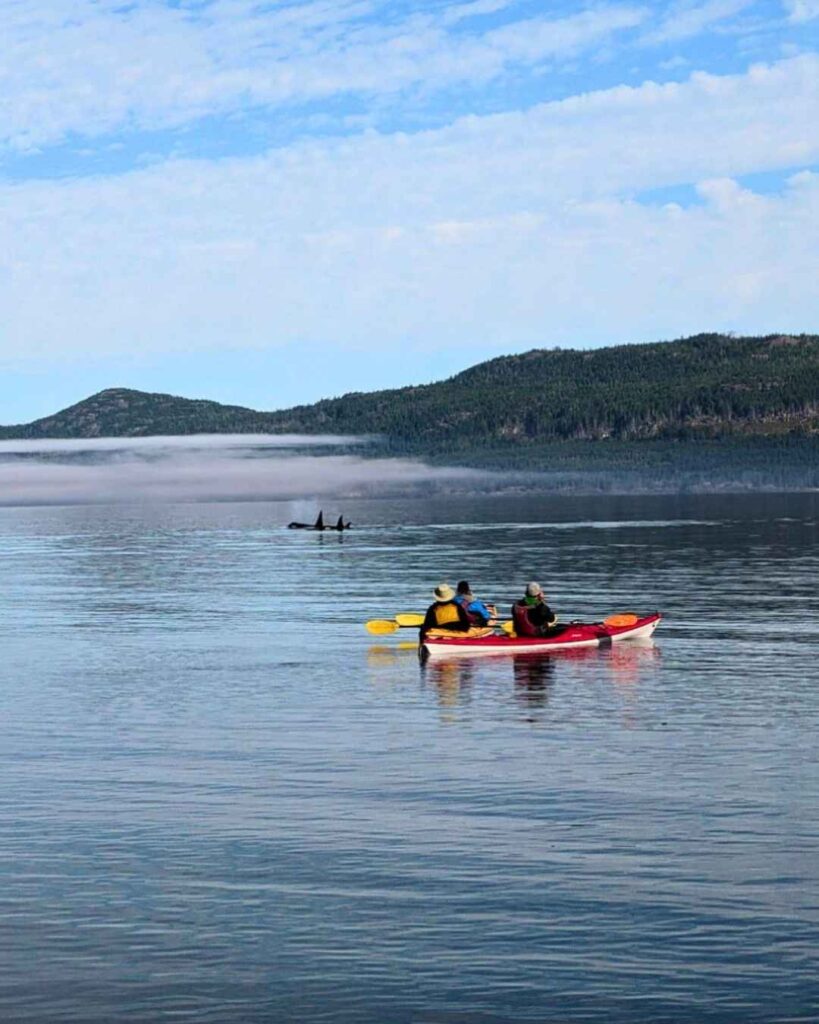
It is safe to say, that Orcas are not interested in humans, but often show curiosity around people, boats and kayaks.