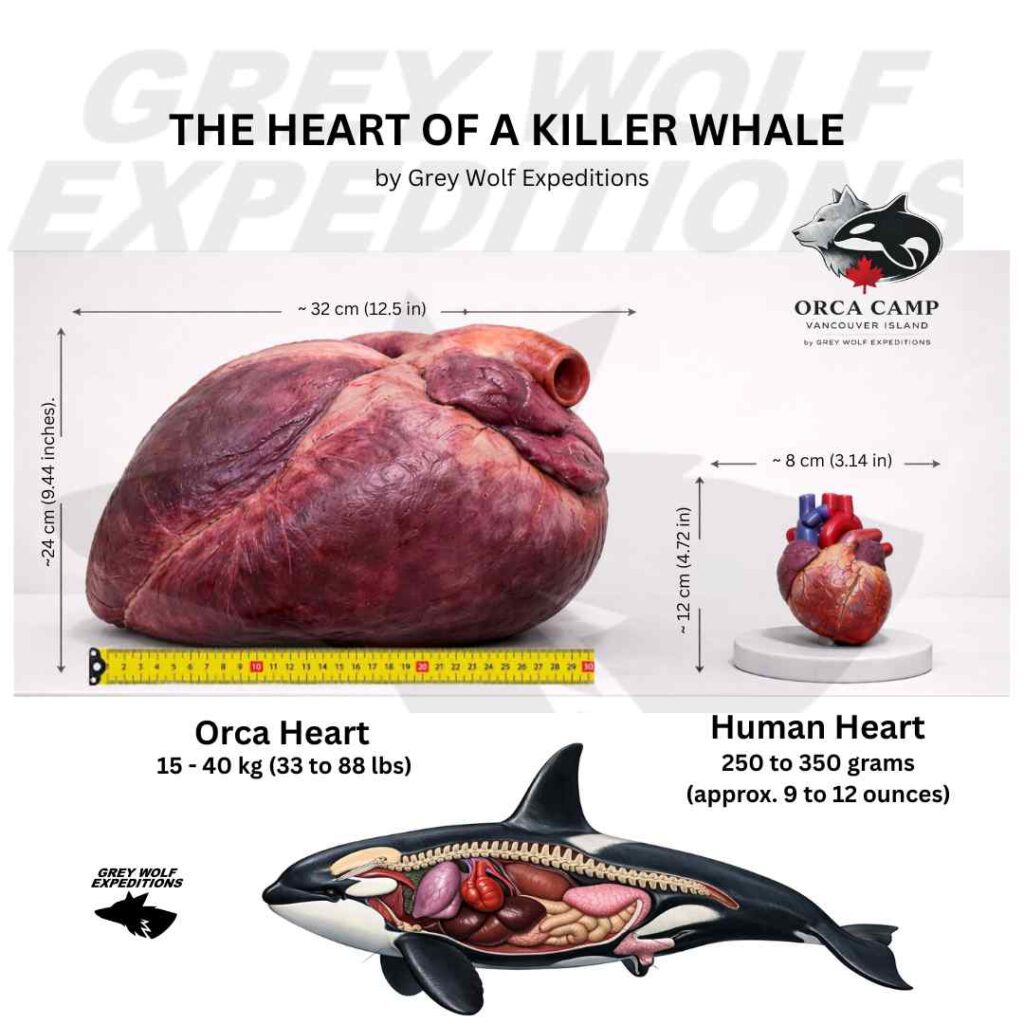


Have you ever wondered what the heart of an orca looks like?
When we watch a killer whale surface — powerful, steady, intentional — it’s easy to feel something shift inside our own chest. That reaction isn’t random. But before we talk about that, let’s talk about the science.
How Big Is an Orca’s Heart?
Surprisingly, there are relatively few detailed anatomical studies on killer whale hearts. One of the most significant examinations occurred in 2016 at the Royal Ontario Museum, where advanced CT scans and endoscopic imaging were performed on a Southern Resident killer whale. Additional anatomical data is archived through scientific literature, including PubMed Central.
Here’s what research tells us:
-
Average weight: ~15–40 kg (33–88 lbs)
-
Percentage of body mass: ~0.5–1.3%
-
Shape: Dorsoventrally flattened (shorter top-to-bottom, broader side-to-side)
-
Interventricular septum length: ~31.6 cm (12.4 in)
-
Aorta internal diameter: ~8.6 cm (3.3 in)
To put that into perspective, the septum alone measures roughly the length of a standard ruler. The aorta? About the diameter of a large orange.
This is not a “Valentine-shaped” heart like we draw in cards. It is wide, muscular, and built for endurance.
Built for Cold Water and Deep Dives
Killer whales are apex marine predators that travel vast distances and dive deep in cold ocean environments. Their heart must pump efficiently under immense pressure, support oxygen conservation during dives, and maintain circulation in frigid water.
The flattened shape allows the organ to sit efficiently within the thoracic cavity and rib cage — a structural adaptation to their hydrodynamic body design.
Everything about it says: strength, efficiency, endurance.
A Human Heart & Energy
Now here’s where it gets interesting.
The human heart produces the strongest electromagnetic field in the body — stronger than the brain. This field is generated by the coordinated electrical activity that drives each heartbeat, and it can be measured several feet away with sensitive scientific instruments.
That doesn’t mean we are “feeling” an orca’s heart energy directly.
But it does mean that when you stand on the water and watch a killer whale surface — and you feel something expand in your chest — your body is responding in a very real way.
Your nervous system shifts.
Your breathing changes.
Your heart rhythm subtly adapts to awe.
Biology Meets Wonder
There is nothing mystical about that moment.
It is biology meeting something extraordinary.
Our hearts respond to power, beauty, scale, and stillness. Orcas embody all of that. Perhaps that is part of why we are so drawn to them.
The science is measurable.
The feeling is undeniable.
And somewhere between the two — is the experience.
Sandra Zgela